

Villa Rufolo: gardens, tower and concerts
It sits on the main square, next to the cathedral, and in an hour it tells you eight centuries of Ravello. Here's how we visit it.
Villa Rufolo is the first villa you come to: the entrance is on Piazza Duomo, about ten minutes' walk from our house in Via Lacco. Inside are the ruins of a thirteenth-century palace, a thirty-metre tower you can climb, and terraced gardens where, in summer, music is played above the sea.
In our guide to things to do in Ravello I gave it only a few lines. This is the close-up: the family who built it, the route from the entrance tower to the belvedere, the garden Wagner loved, the concerts, and the practical things worth knowing before you go in.
- From our house
- 700 m on foot, about 10 minutes
- Time needed
- an hour, a little more with the tower
- Tickets
- at the entrance, no booking
- Best time
- late afternoon
Cover photo: Derbrauni, CC BY-SA 4.0, via Wikimedia Commons.

The Rufolo bankers, a Scotsman and a German composer
In the thirteenth century the Rufolo were among the richest families in Ravello: merchants and bankers with business as far as Sicily and the Angevin court. They built their palace here, next to the cathedral, and one of them gave the Duomo the great pulpit you can still see today. Boccaccio put one of them, Landolfo, into a story in the Decameron: a merchant who loses everything at sea and comes home rich.
The villa then passed to other families and slowly fell into ruin. In 1851 it was bought by Francis Nevile Reid, a Scotsman with a passion for botany, who restored what could be saved, laid out the gardens and even had water piped up to Piazza Vescovado. Since 1974 the villa has been public property, and today it is run by the Fondazione Ravello, which also organises the Festival.
Photo: Mentnafunangann, CC BY-SA 3.0, via Wikimedia Commons.
The route, from the entrance tower to the belvedere
The route is short and well signposted, but there's a lot to look at and it's all close together. My advice: don't head straight for the gardens. The medieval part at the start is the bit tour groups rush through.
The entrance tower and the Moorish cloister
You go in beneath a tower with four statues in its niches, and a tree-lined path leads to the courtyard. The Moorish cloister is the real treasure: two tiers of interlaced arches, slender columns and decoration that feels closer to Arab Sicily than to the Amalfi Coast. Look up at the upper loggia; that's where you realise how wealthy this house must have been.
The Torre Maggiore
This is the thirty-metre tower you can see from all over town. Since 2017 it has held a small museum spread over its floors, and about a hundred steps take you up to the terrace at the top, looking over the old town, the cathedral and the coast. Children under five aren't allowed up. If you have the legs and the time, do it: from above you see the gardens whole, like a drawing.
The Knights' Hall and the remains of the palace
Around the courtyard you walk through what's left of the palace: the Sala dei Cavalieri, restored and used for exhibitions and events, the old Turkish bath, the chapel, the ovens. They are bare rooms, some without a roof, and that's exactly why they help you picture life in a medieval merchant's house better than any explanation.

Klingsor's garden
Further down you reach the gardens, on two terraces. On 26 May 1880 Richard Wagner came here while he was finishing Parsifal: in the diary of his wife Cosima, that day records that they had found Klingsor's magic garden, the one in the second act. The lower terrace has carried that name ever since.
The geometric flowerbeds are in bloom for much of the year, and the colours change with the seasons. At the far end is the belvedere with its umbrella pine, the most photographed spot in Ravello, and straight below you Minori, Maiori and the Gulf of Salerno as far as Capo d'Orso. Sit on the low wall for a moment: this is why people have been making the climb up to Ravello for centuries.
Photo: Derbrauni, CC BY-SA 4.0, via Wikimedia Commons.
Concerts on the belvedere
Every summer since 1953, a stage has gone up on the Villa Rufolo belvedere that seems to hang in mid-air, with the orchestra playing with its back to the sea. It began as concerts in Wagner's memory; today it's the Ravello Festival, with symphonic and chamber music and a few different evenings. In August there's also a dawn concert (in 2026 it was on 11 August): you go in while it's still dark and the music plays as the sun rises behind the mountains.
The programme comes out in spring on ravellofestival.com and the best seats go quickly, so book as soon as the dates are known. A concert up here is the reason many of our guests come back. If you're planning a trip around the Festival, write to us before you buy tickets and we'll tell you whether the house is free on those nights.
Opening hours, tickets and things to know
The villa is open every day, but the hours change with the seasons and may change again on concert days: always check the official Villa Rufolo website. Tickets are sold only at the entrance, with no booking, and there are reductions for children aged 5 to 12 and for over-65s. On the first Saturday of the month there are usually free guided tours in Italian and English, included in the ticket.
Inside there are steps and sloping paths, but it's an easier walk than Cimbrone and you reach it on the level from the square. If you're coming by car, leave it in one of the town's pay car parks: they're listed on our How to reach us page. The handiest café and toilets are in the square, right outside.
Four tips from someone who lives here
- Go in the late afternoon: the day-trip groups have left and the low sun lights up the gulf and the flowerbeds.
- Climb the Torre Maggiore before you go down to the gardens: seeing the layout from above helps you understand how the palace worked.
- For evening concerts bring a light jacket: on the belvedere, once the sun goes down, there's always a breeze off the sea.
- Do Villa Rufolo and the Duomo the same afternoon, they face each other; keep the morning for Villa Cimbrone, right at opening time.
Villa Rufolo: questions our guests ask
How long does it take to visit Villa Rufolo?
An hour is enough for the cloister, the palace remains and the gardens. If you also climb the Torre Maggiore with its small museum, allow another half hour.
Do I need to book Villa Rufolo tickets?
No, tickets are sold only at the entrance on Piazza Duomo. Prices and reductions can change: the up-to-date figures are on the villa's official website.
What does Wagner have to do with Villa Rufolo?
Richard Wagner visited the villa on 26 May 1880 and recognised in its garden the magic garden of Klingsor from the second act of Parsifal. The concerts on the belvedere, begun in 1953 in his memory, became the Ravello Festival.
When are the concerts at Villa Rufolo?
Mainly in summer, during the Ravello Festival, with a dawn concert in August. The programme and tickets are on ravellofestival.com, and seats sell out fast.
Villa Rufolo or Villa Cimbrone?
They're different, and ten minutes' walk apart. Rufolo is on the square and has the medieval cloister, the tower and the concerts; Cimbrone has the larger garden and the Terrace of Infinity. You can easily see both in a day.
After the concert, walk home
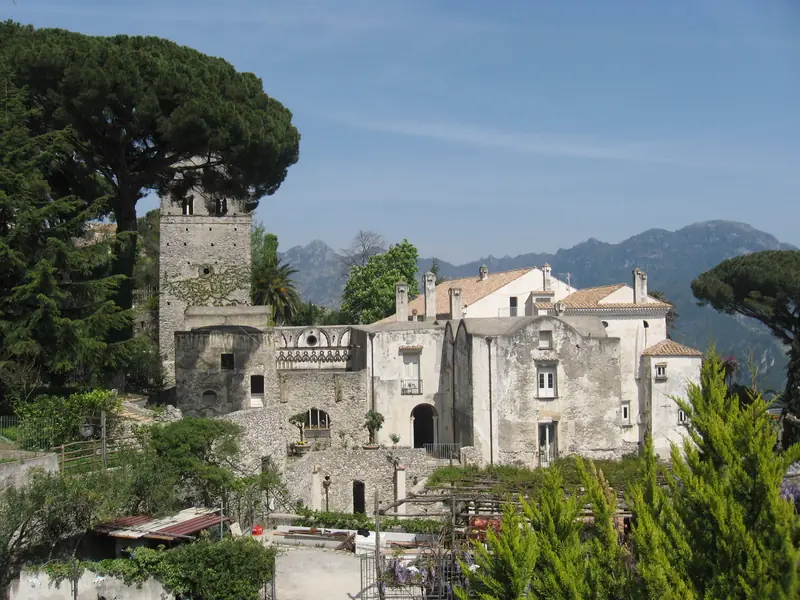
Our holiday apartment is in Via Lacco, ten minutes from the square: after the concert on the belvedere you walk back through the lanes without checking the time of the last bus. Send us your dates and we'll get back to you ourselves.